Hairstylesmagazine Org Content Uploads 2015 Beautiful Hairstyles Long Hair Prom
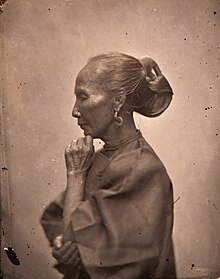
Chinese adult female with an elaborate hair style, 1869

A hairstyle, hairdo, haircut or crew refers to the styling of pilus, commonly on the human scalp. Sometimes, this could likewise mean an editing of facial or body hair. The fashioning of hair can be considered an aspect of personal grooming, fashion, and cosmetics, although practical, cultural, and popular considerations also influence some hairstyles.[1]
The oldest known depiction of pilus styling is hair braiding which dates back well-nigh 30,000 years. In history, women's hair was often elaborately and advisedly dressed in special ways, though it was also oft kept covered outside the home, especially for married women. From the time of the Roman Empire[ citation needed ] until the Centre Ages, most women grew their hair as long every bit information technology would naturally abound. Between the late 15th century and the 16th century, a very high hairline on the forehead was considered attractive. Effectually the same time catamenia, European men oftentimes wore their pilus cropped no longer than shoulder-length. In the early 17th century, male hairstyles grew longer, with waves or curls existence considered desirable.
The male wig was pioneered past King Louis XIII of France (1601–1643) in 1624. Mullets or periwigs for men were introduced into the English language-speaking earth with other French styles in 1660. Belatedly 17th century wigs were very long and wavy, but became shorter in the mid-18th century, by which time they were commonly white. Curt hair for fashionable men was a product of the Neoclassical motion. In the early 19th century the male beard, and also moustaches and sideburns, fabricated a strong reappearance. From the 16th to the 19th century, European women's hair became more visible while their hair coverings grew smaller. In the middle of the 18th century the pouf style developed. During the First Earth War, women around the world started to shift to shorter hairstyles that were easier to manage. In the early 1950s women's hair was generally curled and worn in a variety of styles and lengths. In the 1960s, many women began to wear their pilus in brusk modern cuts such as the pixie cutting, while in the 1970s, pilus tended to be longer and looser. In both the 1960s and 1970s many men and women wore their hair very long and straight.[2] In the 1980s, women pulled back their pilus with scrunchies. During the 1980s, punk hairstyles were adopted by many people.
Prehistory and history [edit]
Throughout times, people take worn their pilus in a wide multifariousness of styles, largely adamant by the fashions of the culture they live in. Hairstyles are markers and signifiers of social grade, age, marital condition, racial identification, political beliefs, and attitudes nigh gender.
Some people may comprehend their pilus totally or partially for cultural or religious reasons. Notable examples of head roofing include women in Islam who wearable the hijab, married women in Haredi Judaism who wear the sheitel or tichel, married Himba men who embrace their hair except when in mourning, Tuareg men who wear a veil, and baptized men and women in Sikhism who wearable the dastar.[iii] [4] [5]

Paleolithic [edit]
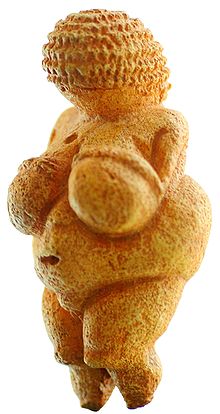
The oldest known reproduction of hair braiding lies back about 30,000 years: the Venus of Willendorf, at present known in academia equally the Woman of Willendorf, of a female figurine from the Paleolithic, estimated to have been made between about 28,000 and 25,000 BCE.[6] The Venus of Brassempouy counts about 25,000 years old and indisputably shows hairstyling.
Bronze Age [edit]

In the Bronze Age, razors were known and in use past some men, but non on a daily basis since the procedure was rather unpleasant and required resharpening of the tool which reduced its endurance.[seven]
Ancient history [edit]
In ancient civilizations, women's hair was often elaborately and carefully dressed in special ways. Women coloured their pilus, curled it, and pinned it up (ponytail) in a multifariousness of ways. They set their hair in waves and curls using wet clay, which they stale in the dominicus and and then combed out, or else by using a jelly made of quince seeds soaked in water, or crimper tongs and curling irons of various kinds.[viii] [ix]
Roman Empire and Middle Ages [edit]
-
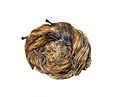
Romano-British hair slice with jet pins found in a atomic number 82 coffin in Roman York
-
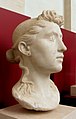
Late 1st century BC portrait of a Roman woman with an elaborate hairstyle found on the Via Latina in Rome
-
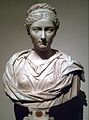
130 AD bust of Vibia Sabina with a hairband and heart parting
Betwixt 27 BC and 102 Ad, in Royal Rome, women wore their hair in complicated styles: a mass of curls on summit, or in rows of waves, drawn back into ringlets or braids. Somewhen noblewomen'due south hairstyles grew and then complex that they required daily attention from several slaves and a stylist in order to be maintained. The hair was often lightened using woods ash, unslaked lime and sodium bicarbonate, or darkened with copper filings, oak-apples or leeches marinated in vino and vinegar.[x] It was augmented by wigs, hairpieces and pads, and held in place by nets, pins, combs and pomade. Under the Byzantine Empire, noblewomen covered most of their hair with silk caps and pearl nets.[11]
From the fourth dimension of the Roman Empire[ commendation needed ] until the Middle Ages, most women grew their hair as long as information technology would naturally grow. It was normally only styled through cut, as women'due south hair was tied up on the head and covered on most occasions when outside the abode by using a snood, kerchief or veil; for an adult woman to vesture uncovered and loose pilus in the street was often restricted to prostitutes. Braiding and tying the hair was mutual. In the 16th century, women began to wear their pilus in extremely ornate styles, ofttimes decorated with pearls, precious stones, ribbons, and veils. Women used a technique called "lacing" or "taping," in which cords or ribbons were used to demark the hair around their heads.[12] During this period, nearly of the hair was braided and hidden nether wimples, veils or couvrechefs. In the subsequently one-half of the 15th century and on into the 16th century, a very high hairline on the forehead was considered attractive, and wealthy women frequently plucked out hair at their temples and the napes of their necks, or used depilatory cream to remove information technology, if information technology would otherwise be visible at the edges of their pilus coverings.[13] Working-course women in this menstruation wore their hair in simple styles.[12]
Early on modern history [edit]
Male styles [edit]
During the 15th and 16th centuries, European men wore their pilus cropped no longer than shoulder-length, with very fashionable men wearing bangs or fringes. In Italia, it was common for men to dye their pilus.[14] In the early 17th century male hairstyles grew longer, with waves or curls being considered desirable in upper-course European men.
The male wig was supposedly pioneered by Male monarch Louis XIII of France (1601–1643) in 1624 when he had prematurely begun to bald.[15] This manner was largely promoted by his son and successor Louis XIV of France (1638–1715) that contributed to its spread in European and European-influenced countries. The beard had been in a long decline and now disappeared among the upper classes.
Perukes or periwigs for men were introduced into the English-speaking globe with other French styles when Charles 2 was restored to the throne in 1660, following a lengthy exile in France. These wigs were shoulder-length or longer, imitating the long hair that had become fashionable among men since the 1620s. Their use shortly became popular in the English language court. The London diarist Samuel Pepys recorded the solar day in 1665 that a barber had shaved his head and that he tried on his new periwig for the beginning time, only in a year of plague he was uneasy near wearing information technology:
3rd September 1665: Upwardly, and put on my coloured silk suit, very fine, and my new periwig, bought a practiced while since, only darst not clothing it because the plague was in Westminster when I bought it. And it is a wonder what volition be the fashion after the plague is done every bit to periwigs, for nobody will dare to buy any hair for fearfulness of the infection? That it had been cutting off the heads of people expressionless of the plague.
Late 17th-century wigs were very long and wavy (see George I beneath), but became shorter in the mid-18th century, by which time they were usually white (George 2). A very common manner had a single stiff curl running round the head at the finish of the hair. By the late 18th century the natural hair was frequently powdered to achieve the impression of a short wig, tied into a pocket-size tail or "queue" backside (George Iii).
Brusque hair for fashionable men was a product of the Neoclassical movement. Classically inspired male hair styles included the Bedford Crop, arguably the forerunner of most manifestly modern male styles, which was invented by the radical politico Francis Russell, 5th Knuckles of Bedford as a protestation against a tax on hair powder; he encouraged his friends to adopt it by betting them they would not. Another influential style (or group of styles) was named by the French "à la Titus" after Titus Junius Brutus (not in fact the Roman Emperor Titus as often assumed), with hair short and layered just somewhat piled upwardly on the crown, often with restrained quiffs or locks hanging downward; variants are familiar from the hair of both Napoleon and George IV. The fashion was supposed to have been introduced past the actor François-Joseph Talma, who upstaged his wigged co-actors when appearing in productions of works such as Voltaire's Brutus (about Lucius Junius Brutus, who orders the execution of his son Titus). In 1799, a Parisian fashion magazine reported that fifty-fifty bald men were adopting Titus wigs,[16] and the way was besides worn by women, the Journal de Paris reporting in 1802 that "more than than half of elegant women were wearing their hair or wig à la Titus."[17]
In the early 19th century the male person bristles, and also moustaches and sideburns, made a strong reappearance, associated with the Romantic movement, and all remained very mutual until the 1890s, after which younger men ceased to habiliment them, with Globe War I, when the majority of men in many countries saw military service, finally despatching the full bristles except for older men retaining the styles of their youth, and those affecting a Bohemian look. The short military-manner moustache remained popular.
Female styles [edit]

From the 16th to the 19th century, European women's hair became more than visible while their hair coverings grew smaller, with both becoming more than elaborate, and with hairstyles beginning to include decoration such as flowers, ostrich plumes, ropes of pearls, jewels, ribbons and small crafted objects such as replicas of ships and windmills.[12] [18] Bound hair was felt to exist symbolic of propriety: loosening one's hair was considered immodest and sexual, and sometimes was felt to accept supernatural connotations.[19] Ruby pilus was popular, particularly in England during the reign of the cerise-haired Elizabeth I, and women and aloof men used borax, saltpeter, saffron and sulfur powder to dye their pilus blood-red, making themselves nauseated and giving themselves headaches and nosebleeds.[10] [20] During this period in Kingdom of spain and Latin cultures, women wore lace mantillas, often worn over a high rummage,[12] [21] and in Buenos Aires, there developed a manner for extremely large tortoise-crush hair combs called peinetón, which could measure out upwards to three feet in height and width, and which are said by historians to have reflected the growing influence of France, rather than Spain, upon Argentinians.[22]
In the centre of the 18th century the pouf mode developed, with women creating book in the pilus at the front of the head, commonly with a pad underneath to lift it higher, and ornamented the back with seashells, pearls or gemstones. In 1750, women began dressing their hair with perfumed pomade and powdering it white. But before World War I, some women began wearing silk turbans over their hair.[12]
Nippon [edit]
In the early 1870s, in a shift that historians attribute to the influence of the Westward,[23] Japanese men began cutting their hair into styles known as jangiri or zangiri (which roughly ways "random cropping").[24] During this period, Japanese women were still wearing traditional hairstyles held upwardly with combs, pins, and sticks crafted from tortoise, metal, wood and other materials,[12] but in the middle 1880s, upper-form Japanese women began pushing back their pilus in the Western way (known as sokuhatsu ), or adopting Westernized versions of traditional Japanese hairstyles (these were called yakaimaki , or literally, "soirée chignon").[24]

Inter-war years [edit]
During the First World War, women around the world started to shift to shorter hairstyles that were easier to manage. In the 1920s women started for the outset time to bob, shingle and crop their pilus, often covering it with small head-hugging cloche hats. In Korea, the bob was called tanbal .[25] Women began marcelling their hair, creating deep waves in information technology using heated scissor irons. Durable permanent waving became popular also in this period:[26] it was an expensive, uncomfortable and fourth dimension-consuming procedure, in which the hair was put in curlers and inserted into a steam or dry rut auto. During the 1930s women began to article of clothing their hair slightly longer, in pageboys, bobs or waves and curls.[11]
During this period, Western men began to wear their pilus in means popularized by movie stars such equally Douglas Fairbanks, Jr. and Rudolph Valentino. Men wore their hair short, and either parted on the side or in the eye, or combed direct back, and used pomade, creams and tonics to keep their hair in place. At the beginning of the Second World War and for some time afterwards, men'southward haircuts grew shorter, mimicking the armed services crewcut.[27]
During the 1920s and 1930s, Japanese women began wearing their hair in a fashion called mimi-kakushi (literally, "ear hiding"), in which pilus was pulled dorsum to encompass the ears and tied into a bun at the nape of the cervix. Waved or curled hair became increasingly pop for Japanese women throughout this catamenia, and permanent waves, though controversial, were extremely popular. Bobbed hair also became more popular for Japanese women, mainly among actresses and moga , or "cut-hair girls," young Japanese women who followed Westernized fashions and lifestyles in the 1920s.[24]
Post-state of war years [edit]
After the state of war, women started to wear their hair in softer, more than natural styles. In the early on 1950s women's hair was generally curled and worn in a variety of styles and lengths. In the later 1950s, loftier bouffant and beehive styles, sometimes nicknamed B-52s for their similarity to the bulbous noses of the B-52 Stratofortress bomber, became popular.[28] During this catamenia many women done and gear up their hair only once a week, and kept information technology in place past wearing curlers every night and reteasing and respraying it every morning.[29] In the 1960s, many women began to vesture their pilus in short mod cuts such as the pixie cut, while in the 1970s, hair tended to be longer and looser. In both the 1960s and 1970s many men and women wore their hair very long and straight.[2] Women straightened their hair through chemical straightening processes, by ironing their hair at home with a clothes iron, or by rolling information technology up with large empty cans while moisture.[30] African-American men and women began wearing their hair naturally (unprocessed) in large Afros, sometimes ornamented with Afro picks made from wood or plastic.[12] By the cease of the 1970s the Afro had fallen out of favour amongst African-Americans, and was beingness replaced past other natural hairstyles such as corn rows and dreadlocks.[31]


Woman wearing a loose Afro
Contemporary hairstyles [edit]

Human with styled hair, 2011
Since the 1960s and 70s, women accept worn their hair in a wide diversity of fairly natural styles. In the 1980s, women pulled back their hair with scrunchies, stretchy ponytail holders made from cloth over fabric bands. Women also often wear glittery ornaments today, likewise as claw-fashion barrettes used to secure ponytails and other upswept or partially upswept hairstyles.[12] Today, women and men can choose from a broad range of hairstyles, but they are still expected to wear their hair in ways that conform to gender norms: in much of the globe, men with long pilus and women whose hair does not appear carefully groomed may face various forms of discrimination, including harassment, social shaming or workplace discrimination.[32] This is somewhat less true of African-American men, who wear their hair in a diverseness of styles that overlap with those of African-American women, including box braids and cornrows fastened with rubber bands and dreadlocks.[33]
Defining factors [edit]
A hairstyle's aesthetic considerations may be determined past many factors, such as the subject's physical attributes and desired self-image and/or the stylist'due south artistic instincts.
Physical factors include natural hair type and growth patterns, face and caput shape from various angles, and overall body proportions; medical considerations may likewise apply. Self-image may be directed toward conforming to mainstream values (military-style coiffure cuts or current "fad" hairstyles such as the Dido flip), identifying with distinctively clean-cut subgroups (due east.g., punk hair), or obeying religious dictates (e.k., Orthodox Jewish accept payot, Rastafari accept Dreadlocks, North India jatas, or the Sikh practice of Kesh), though this is highly contextual such that "mainstream" expect in 1 setting may be limited to a "subgroup" in another.
A hairstyle is achieved by arranging hair in a certain style, occasionally using combs, a accident-dryer, gel, or other products. The practice of styling pilus is often called hairdressing, especially when done as an occupation.
Hairstyling may likewise include adding accessories (such as headbands or barrettes) to the hair to hold it in place, raise its ornamental appearance, or partially or fully conceal information technology with coverings such as a kippa, hijab, tam or turban.
Process [edit]

In the Usa, cosmetology students purchase practice heads from man hair to learn cutting, coloring and styling
Hair dressing may include cuts, weaves, coloring, extensions, perms, permanent relaxers, curling, and any other class of styling or texturing.
Washing [edit]
Stylists often wash a bailiwick'south pilus commencement, and so that the pilus is cutting while even so slightly damp. Compared to dry pilus, wet hair can be easier to manage in a cutting/style situation because the added weight and surface tension of the water cause the strands to stretch downward and cling together along the pilus'south length, holding a line and making it easier for the stylist to create a form. It is important to note that this method of cut hair while wet, may exist near suitable (or common) for directly hair types. Curly, kinky and other types of hair textures with considerable volume may benefit from cut while dry, equally the hair is in a more natural state and the hair tin can be cut evenly.
Cut [edit]
Hair cutting or hair trimming is intended to create or maintain a specific shape and form. There are means to trim one's own hair but usually another person is enlisted to perform the process, as it is difficult to maintain symmetry while cutting hair at the dorsum of one'due south head.
Cutting hair is often done with hair clipper, scissors, and razors. Combs and hair grips are often employed to isolate a department of hair which is so trimmed.
Brushing and combing [edit]
Brushes and combs are used to organize and untangle the pilus, encouraging all of the strands to prevarication in the same management and removing droppings such every bit lint, dandruff, or hairs that take already shed from their follicles but proceed to cling to the other hairs.
There are all way of detangling tools available in a wide variety of price ranges. Combs come in all shapes and sizes and all mode of materials including plastics, wood, and horn. Similarly, brushes also come up in all sizes and shapes, including various paddle shapes. Most do good from using some grade of a wide tooth comb for detangling. Most physicians advise against sharing pilus intendance instruments like combs and clips, to prevent spreading hair weather like dandruff and caput lice.
The historical dictum to brush pilus with one hundred strokes every twenty-four hours is somewhat archaic, dating from a time when pilus was washed less frequently; the brushstrokes would spread the scalp'due south natural oils down through the pilus, creating a protective effect. Now, however, this does not use when the natural oils have been washed off by frequent shampoos. Also, hairbrushes are at present usually made with rigid plastic bristles instead of the natural boar'south bristles that were one time standard; the plastic bristles increase the likelihood of actually injuring the scalp and pilus with excessively vigorous brushing. Withal, traditional brushes with boar'south bristles are nonetheless usually used among African Americans and those with coarse or kinky textures to soften and lay downward curls and waves.
Drying [edit]
Hair dryers speed the drying process of hair by blowing air, which is usually heated, over the wet hair shaft to accelerate the rate of h2o evaporation.
Excessive estrus may increase the rate of shaft-splitting or other damage to the hair. Pilus dryer diffusers can be used to widen the stream of air flow then it is weaker but covers a larger area of the hair.
Hair dryers can also exist used equally a tool to sculpt the hair to a very slight caste. Proper technique involves aiming the dryer such that the air does not blow onto the face or scalp, which can cause burns.
Other common hair drying techniques include towel drying and air drying.
Braiding and updos [edit]
Tight or frequent braiding may pull at the hair roots and cause traction alopecia. Rubber bands with metal clasps or tight clips, which curve the pilus shaft at extreme angles, tin have the same effect.

An updo is a hair style that involves arranging the hair and so that it is pointing upwards. It tin can be as unproblematic as a ponytail, merely is more commonly associated with more elaborate styles intended for special occasions such as a prom or weddings.
If hair is pinned as well tightly, or the whole updo slips causing pulling on the hair in the follicle at the pilus root, it can cause aggravation to the pilus follicle and result in headaches. Although some people of African heritage may utilise braiding extensions (long term braiding hairstyle) equally a course of convenience and/or as a reflection of personal style, information technology is important not to keep the braids upwards longer than needed to avert pilus breakage or pilus loss. Proper braiding technique and maintenance can result in no hair damage even with repeated braid styles.
Curling and straightening [edit]
Curling and straightening hair requires the stylist to utilize a curling rod or a flat iron to get a desired await. These irons use heat to manipulate the hair into a variety of waves, curls and reversing natural curls and temporarily straightening the hair. Straightening or even crimper pilus can impairment it due to straight heat from the iron and applying chemicals afterwards to keep its shape. There are irons that accept a part to straighten or curl pilus even when its damp (from showering or wetting the hair), but this requires more heat than the average iron (temperatures can range from 300 to 450 degrees). Heat protection sprays and pilus-repairing shampoos and conditioners can protect hair from impairment caused by the direct heat from the irons.
Industry [edit]
Hair styling is a major globe manufacture, from the salon itself to products, advertising, and even magazines on the subject. In the United states of america, near hairstylists are licensed after obtaining preparation at a cosmetology or dazzler school.[34]
In recent years, competitive events for professional person stylists have grown in popularity. Stylists compete on borderline to create the most elaborate hairstyle using props, lights and other accessories.
Tools [edit]
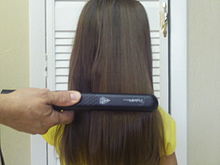
Styling tools may include hair irons (including flat, curling, and crimping irons), pilus dryers, hair brushes and hair rollers. Hair dressing might as well include the use of pilus product to add together texture, shine, curl, volume or hold to a particular manner. Hairpins are as well used when creating particular hairstyles. Their uses and designs vary over different cultural backgrounds.
Products [edit]
Styling products aside from shampoo and conditioner are many and varied. Leave-in conditioner, workout treatments, mousse, gels, lotions, waxes, creams, clays, serums, oils, and sprays are used to change the texture or shape of the hair, or to hold it in place in a sure fashion. Applied properly, most styling products will not damage the hair apart from drying it out; most styling products contain alcohols, which can deliquesce oils. Many hair products contain chemicals which tin crusade build-up, resulting in dull pilus or a change in perceived texture.Hairbrush
Wigs [edit]

In the tardily 18th century and early 19th century, powdered wigs were popular
Care of human being or other natural hair wigs is similar to care of a normal head of pilus in that the wig tin can be brushed, styled, and kept make clean using haircare products.
Constructed wigs are normally made from a fine fiber that mimics man pilus. This cobweb can be fabricated in most any colour and hairstyle, and is frequently glossier than homo hair. However, this fiber is sensitive to heat and cannot be styled with flat irons or curling irons. In that location is a newer synthetic fiber that tin take heat up to a sure temperature.
Human hair wigs tin can exist styled with estrus, and they must be brushed only when dry. Synthetic and human hair wigs should be brushed dry before shampooing to remove tangles. To clean the wig, the wig should be dipped into a container with water and balmy shampoo, then dipped in clear h2o and moved up and down to remove excess water. The wig must and then be air dried naturally into its ain hairstyle. Proper maintenance can brand a human hair wig last for many years.
Functional and decorative ornaments [edit]
In that location are many options to embellish and accommodate the hair. Hairpins, clasps, barrettes, headbands, ribbons, safe bands, scrunchies, and combs can be used to achieve a variety of styles. In that location are also many decorative ornaments that, while they may take clasps to affix them to the pilus, are used solely for advent and exercise not aid in keeping the pilus in place. In India for example, the Gajra (blossom garland) is common at that place are heaps on hairstyles.
Social and cultural implications [edit]
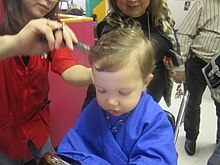
A i-twelvemonth-old kid getting his beginning haircut
Gender [edit]
At nearly times in most cultures, men have worn their hair in styles that are different from women'southward. American sociologist Rose Weitz one time wrote that the well-nigh widespread cultural rule about hair is that women'due south hair must differ from men'due south hair.[35] An exception is the men and women living in the Orinoco-Amazon Basin, where traditionally both genders have worn their hair cut into a bowl shape. In Western countries in the 1960s, both young men and young women wore their pilus long and natural, and since then it has become more common for men to grow their hair.[36] During nearly periods in human history when men and women wore similar hairstyles, every bit in the 1920s and 1960s, information technology has generated pregnant social concern and approbation.[37]
Organized religion [edit]
Pilus in religion likewise plays an important role since women and men, when deciding to dedicate their life to religion, often modify their haircut. Catholic nuns oft cutting their hair very short, and men who joined Cosmic monastic orders in the eighth century adopted what was known as the tonsure, which involved shaving the tops of their heads and leaving a ring of hair around the bald crown.[36] Many Buddhists, Hajj pilgrims and Vaisnavas, especially members of the Hare Krishna move who are brahmacharis or sannyasis, shave their heads. Some Hindu and most Buddhist monks and nuns shave their heads upon entering their society, and Korean Buddhist monks and nuns have their heads shaved every 15 days.[38] Adherents of Sikhism are required to wear their hair unshorn. Women ordinarily article of clothing information technology in a braid or a bun and men cover it with a turban.
Marital status [edit]
In the 1800s, American women started wearing their pilus up when they became gear up to get married. Among the Fulani people of west Africa, unmarried women vesture their hair ornamented with small amber beads and coins, while married women wear large bister ornaments. Marriage is signified among the Toposa women of South Sudan by wearing the hair in many small pigtails. Unmarried Hopi women have traditionally worn a "butterfly" hairstyle characterized by a twist or whorl of hair at each side of the face.[39] Hindu widows in India used to shave their heads equally part of their mourning, although this exercise has mostly disappeared now.
Life transitions [edit]
In many cultures, including Hindu culture and amongst the Wayana people of the Guiana highlands, young people accept historically shaved off their hair to denote coming-of-age. Women in India historically have signified machismo past switching from wearing two braids to i. Among the Rendille of north-eastern Kenya and the Tchikrin people of the Brazilian rainforest, both men and women shave their heads later the death of a close family member. When a man died in ancient Greece, his married woman cutting off her hair and cached it with him,[36] and in Hindu families, the chief mourner is expected to shave his or her head 3 days afterwards the death.[40]
[edit]
Throughout history, hair has been a signifier of social course.
Upper-grade people take always used their hairstyles to signal wealth and status. Wealthy Roman women wore complex hairstyles that needed the labours of several people to maintain them,[41] and rich people have also often chosen hairstyles that restricted or encumbered their move, making it obvious that they did non demand to work.[42] Wealthy people's hairstyles used to be at the cutting edge of way, setting the styles for the less wealthy. Only today, the wealthy are by and large observed to wear their hair in conservative styles that appointment back decades prior.[43]
Middle-course hairstyles tend to exist understated and professional. Middle-class people aspire to take their hair look healthy and natural, implying that they have the resources to live a healthy lifestyle and take good intendance of themselves.
Historically, working-course people'due south haircuts accept tended to be practical and simple. Working-class men have oftentimes shaved their heads or worn their hair close-cropped, and working-class women accept typically pulled their pilus up and off their faces in simple styles. However, today, working-class people ofttimes accept more than elaborate and style-conscious hairstyles than other social classes. Many working-class Mexican men in American cities wear their hair in styles similar the Mongolian (shaved except for a tuft of hair at the nape of the neck) or the rat tail (crewcut on elevation, tuft at the nape), and African-Americans often vesture their hair in circuitous patterns of box braids and cornrows, fastened with barrettes and beads, and sometimes including shaved sections or brilliant color. Sociologists say these styles are an endeavor to express individuality and presence in the confront of social denigration and invisibility.[44]
Haircuts in space [edit]

Haircuts too occur in the International Space Station. During the various expeditions astronauts use pilus clippers attached to vacuum devices for grooming their colleagues so that the cut hair volition not drift inside the weightless environs of the space station and become a nuisance to the astronauts or a adventure to the sensitive equipment installations within the station.[46] [47] [48]
Haircutting in space was also used for charitable purposes in the instance of astronaut Sunita Williams who obtained such a haircut by fellow astronaut Joan Higginbotham inside the International Space Station. Sunita's ponytail was brought back to earth with the STS-116 crew and was donated to Locks of Honey.[49] [50]
See too [edit]
- Asymmetric cut
- Eponymous hairstyle
- Historical Christian hairstyles
- Listing of hairstyles
- Regular haircut
- Roman hairstyles
- Osadia
- Hair loss
References [edit]
- ^ "1940s Hairstyles - For Long Hair - For Short Hair - How To Hair Styles". x November 2011.
- ^ a b Yarwood, Doreen (1978). The Encyclopedia of World Costume. New York: Scribner. p. 220. ISBN0-517-61943-1.
- ^ "Taxonomy of the Sheitel". The Frontward . Retrieved 27 February 2018.
- ^ "Women > Veiling > What is the Hijab and Why do Women Article of clothing it? - Arabs in America". arabsinamerica.unc.edu . Retrieved 27 Feb 2018.
- ^ "The Gift of Dastar | SikhNet". SikhNet . Retrieved 27 February 2018.
- ^ "Nude woman (Venus of Willendorf)" – via www.khanacademy.org.
- ^ Harding, Anthony. "Razors and male identity in the Bronze Age". Durch die Zeiten (Festschrift für Albrecht Jockenhövel).
- ^ Yarwood, Doreen (1978). The Encyclopedia of World Costume. New York: Scribner. pp. 216–220. ISBN0-517-61943-one.
- ^ Sherrow, Victoria (2001). For Appearance' Sake: The Historical Encyclopedia of Good Looks, Dazzler, and Training. Greenwood. p. 142. ISBN978-one-57356-204-i.
- ^ a b Adams, David and Jacki Wadeson (1998). The Art of Pilus Colouring. Cengage Publishing. p. 1. ISBN978-1-86152-894-0.
- ^ a b Yarwood, Doreen (1978). The Encyclopedia of Earth Costume. New York: Scribner. p. 216. ISBN0-517-61943-ane.
- ^ a b c d e f thou h Sherrow, Victoria (2006). Encyclopedia of hair: a cultural history. Greenwood. p. 2. ISBN0-313-33145-half-dozen.
- ^ Davis, Natalie Zemon and Arlette Farge (1993). A history of women in the west volume III: Renaissance and enlightenment paradoxes. Belknap Press. p. 62. ISBN978-0674403727.
- ^ Condra, Jill (2007). The Greenwood Encyclopedia of Wear through Globe History: Book 2, 1501–1800. Greenwood. pp. 45 and 72. ISBN978-0-313-33664-5.
- ^ marcelgomessweden. "Louis XIII « The Beautiful Times". Thebeautifultimes.wordpress.com. Retrieved 16 Jan 2013.
- ^ Hunt, Lynn, "Freedom of Dress in Revolutionary France", p. 243, in From the Royal to the Republican Body: Incorporating the Political in Seventeenth- and Eighteenth-Century France, Editors: Sara E. Melzer, Kathryn Norberg, 1998, University of California Press, 1998, ISBN 0520208072,9780520208070
- ^ Rifelj, Carol De Dobay, Coiffures: Hair in Nineteenth-Century French Literature and Culture, p. 35, 2010, University of Delaware Press, ISBN 0874130999, 9780874130997, Google Books
- ^ Sherrow, Victoria (2001). For Advent' Sake: The Historical Encyclopedia of Adept Looks, Beauty, and Grooming. Greenwood. p. 143. ISBN978-i-57356-204-1.
- ^ Condra, Jill (2007). The Greenwood Encyclopedia of Clothing Through World History: 1501–1800. Greenwood. p. 149. ISBN978-0-313-33664-five.
- ^ Sherrow, Victoria (2001). For Appearance' Sake: The Historical Encyclopedia of Good Looks, Dazzler, and Grooming. Greenwood. ISBN978-1-57356-204-ane.
- ^ Keyes, Jean (1967). A history of women's hairstyles,1500–1965. Methuen. ASIN B0000CNN46.
- ^ Root, Regina A. (2005). The Latin American style reader (Apparel, Body, Culture). Berg Publishers. p. 33. ISBN978-one-85973-893-1.
- ^ O'Brien, Suzanne Thousand. (10 November 2008). "Splitting Hairs: History and the Politics of Daily Life in Nineteenth-Century Nippon". The Journal of Asian Studies. 67 (4): 1309–1339. doi:10.1017/S0021911808001794. S2CID 145239880. Retrieved xix September 2011.
- ^ a b c Slade, Toby (2010). Japanese Fashion: a Cultural History. Berg Publishers. ISBN978-1-84788-252-iii.
- ^ Jun Yoo, Theodore (2008). The politics of gender in colonial Korea: instruction, labor, and health, 1910–1945. University of California Printing. p. 76. ISBN978-0-520-25288-two.
- ^ "Women Getting their Hair Done at the Chez Marie Beauty Shop". World Digital Library. Retrieved eight Feb 2013.
- ^ Peterson, Amy T. and Ann T. Kellogg (2008). The Greenwood encyclopedia of clothing through American history. Greenwood. p. 278. ISBN978-0-313-35855-v.
- ^ Patrick, Bethanne Kelly, and John Thompson, Henry Petroski (2009). An Uncommon History of Common Things. National Geographic. p. 206. ISBN978-1-4262-0420-iii.
- ^ Craats, Rennay (2001). History of the 1960s. Weigl Publishers. p. xv. ISBN978-ane-930954-29-8.
- ^ Sherrow, Victoria (2001). For Appearance' Sake: The Historical Encyclopedia of Expert Looks, Beauty, and Grooming. Greenwood. p. 144. ISBN978-i-57356-204-1.
- ^ Biddle-Perry, Geraldine, and Sarah Cheang (2008). Pilus: styling, culture and style. London: Berg Publishers. p. 125. ISBN978-1-84520-792-2.
- ^ Weitz, Rose (2004). Rapunzel's Daughters: What Women's Hair Tells Us Almost Women's Lives. Farrar, Straus and Giroux. ISBN978-0-374-24082-0.
- ^ Banks, Ingrid (2008). Pilus matters: beauty, power, and Black women'south consciousness. New York: NYU Press. ISBN978-0-8147-1337-ii.
- ^ The American Association of Cosmetology Schools
- ^ Ofek, Galia (2009). Representations of hair in Victorian literature and culture. Ashgate. ISBN978-0-7546-6161-0.
- ^ a b c Sherrow, Victoria (2001). For Advent' Sake: The Historical Encyclopedia of Practiced Looks, Beauty, and Training. Greenwood. p. 141. ISBN978-i-57356-204-one.
- ^ DeMello, Margo (2007). Encyclopedia of body adornment. Greenwood. p. 141. ISBN978-0-313-33695-9.
- ^ Geraldine A. Larkin, First Yous Shave Your Caput, Celestial Arts (2001), ISBN 1-58761-009-4
- ^ Sherrow, Victoria (2001). For Appearance' Sake: The Historical Encyclopedia of Adept Looks, Dazzler, and Preparation. Greenwood. pp. 141–143. ISBN978-ane-57356-204-1.
- ^ ul Hassan, Syed Siraj (1920). The castes and tribes of H.East.H. the Nizam'south dominions, Book ane. Bombay: The Times Press. p. 46.
- ^ Winter, Bruce West. (2003). Roman wives, Roman widows: the appearance of new women and the Pauline communities. Wm. B. Eerdmans Publishing Company. p. 104. ISBN978-0-8028-4971-7.
- ^ Ofek, Galia (2009). Representations of hair in Victorian literature and culture. Ashgate. p. 2. ISBN978-0-7546-6161-0.
- ^ Fussell, Paul (1992). Class: A Guide Through the American Status Organisation. Touchstone. p. 54. ISBN978-0-671-79225-1.
- ^ Sánchez-Jankowski, Martin (2 September 2008). Cracks in the Pavement: Social Alter and Resilience in Poor Neighborhoods. University of California Press. pp. 202–203. ISBN978-0-520-25675-0.
- ^ "Spaceflight gallery". Archived from the original on one April 2011.
- ^ "International Infinite Station Imagery ISS016-E-014192 (one Dec. 2007)". NASA. Archived from the original on 8 December 2007. Retrieved twenty November 2012.
- ^ Williams, Sunita. "Periodical of Sunita Williams". Retrieved twenty November 2012.
Then, you may be wondering how we do this and non get hair all over the identify…Can you figure out how we practise this by the pic?
- ^ Edward T. Lu. "Greetings Earthlings". Archived from the original on half dozen September 2003.
- ^ CollectSpace.com (20 December 2006). "Astronaut cuts her hair in space for clemency". Retrieved 8 June 2007.
- ^ Pearlman, Robert Z. (19 December 2006). "Astronaut Cuts Her Hair in Space for Charity". Space.com. Retrieved 20 November 2012.
External links [edit]
Source: https://en.wikipedia.org/wiki/Hairstyle

Postar um comentário for "Hairstylesmagazine Org Content Uploads 2015 Beautiful Hairstyles Long Hair Prom"