On Young the Resltess Why Are They Changing Phyllis Again?
It took 400,000 Nasa employees and contractors to put Neil Armstrong and Fizz Aldrin on the moon in 1969 – but only one man to spread the idea that it was all a hoax. His name was Nib Kaysing.
It began as "a hunch, an intuition", before turning into "a true conviction" – that the Usa lacked the technical prowess to make information technology to the moon (or, at to the lowest degree, to the moon and back). Kaysing had really contributed to the US space programme, albeit tenuously: between 1956 and 1963, he was an employee of Rocketdyne, a company that helped to design the Saturn V rocket engines. In 1976, he self-published a pamphlet called Nosotros Never Went to the Moon: America's Thirty Billion Dollar Swindle, which sought evidence for his conviction by means of grainy photocopies and ludicrous theories. Yet somehow he established a few perennials that are kept live to this twenty-four hour period in Hollywood movies and Play tricks News documentaries, Reddit forums and YouTube channels.
Despite the boggling volume of evidence (including 382kg of moon stone nerveless across six missions; corroboration from Russia, Japan and Cathay; and images from the Nasa Lunar Reconnaissance Orbiter showing the tracks fabricated by the astronauts in the moondust), belief in the moon-hoax conspiracy has blossomed since 1969. Among 9/11 truthers, anti-vaxxers, chemtrailers, apartment-Earthers, Holocaust deniers and Sandy Hook conspiracists, the idea that the moon landings were faked isn't even a source of acrimony any more – it is just a given fact.
The podcast kingpin Joe Rogan is among the doubters. And so too is the YouTuber Shane Dawson. A sociology professor in New Jersey was exposed last yr for telling his students the landings were faux. While Kaysing relied on photocopied samizdat to alert the world, now conspiracists have the subreddit r/moonhoax to certificate how Nasa was "so lazy" it used the same moon rover for Apollo 15, 16 and 17; or how "they have been trolling us for years"; or to bring up the fact in that location is "i thing I can't become my head around ..."
"The reality is, the cyberspace has made it possible for people to say any the hell they similar to a broader number of people than ever before," sighs Roger Launius, a one-time chief historian of Nasa. "And the truth is, Americans dearest conspiracy theories. Every time something big happens, somebody has a counter-explanation."
It turns out British people love conspiracy theories, besides. Last year, the daytime TV show This Morning welcomed a guest who argued that no one could have walked on the moon as the moon is made of lite. Martin Kenny claimed: "In the past, you saw the moon landings and there was no way to check any of it. Now, in the age of engineering, a lot of immature people are now investigating for themselves." A recent YouGov poll institute that one in six British people agreed with the statement: "The moon landings were staged." Four per cent believed the hoax theory was "definitely true", 12% that it was "probably true", with a further 9% registering as don't knows. Moon hoaxism was more prevalent among the young: 21 % of 24- to 35-twelvemonth-olds agreed that the moon landings were staged, compared with 13% of over-55s.
Kaysing'southward original queries are fuelling this. One is the fact that no stars are visible in the pictures; another is the lack of a boom crater under the landing module; a third is to practise with the mode the shadows fall. People who know what they are talking near take wasted hours explaining such "anomalies" (they are to do with, respectively, photographic camera-exposure times, the way thrust works in a vacuum and the reflective qualities of moondust). Yet until his death in 2005, Kaysing maintained that the whole thing was a fraud, filmed in a Television receiver studio. "Information technology's well documented that Nasa was oftentimes desperately managed and had poor quality command," he told Wired in 1994. "But as of 1969, we could suddenly perform manned flight upon manned flight? With complete success? It's only against all statistical odds."
He was right about that at to the lowest degree. When the Soviets launched Sputnik one in October 1957 (followed one calendar month after by Sputnik 2, containing Laika the canis familiaris), the US space programme was all but non-existent. Nasa was founded in 1958 and managed to launch Alan Shepard into infinite in May 1961 – but when John F Kennedy announced that the The states "should commit itself to achieve the goal, before this decade is out, of landing a man on the moon and returning him safely to the Earth", it seemed a stretch. By the mid-60s, Nasa was consuming more than than 4% of the US federal budget, merely while the Soviets were achieving more firsts – the first adult female in space (1963), the start extra-vehicular activity, ie spacewalk (1965) – the Americans experienced various setbacks, including a launchpad burn that killed all three Apollo 1 astronauts.
If you lot take always been to the Science Museum in London, y'all volition know that the lunar module was basically fabricated of tinfoil. Apollo viii had orbited the moon in 1968, only, equally Armstrong remarked, correcting course and landing on the moon was "far and away the most circuitous office of the flight". He rated walking around on the surface one out of 10 for difficulty (despite the problems he had with the Idiot box cable wrapping around his feet), "but I thought the lunar descent was probably a 13".
That is until you compare it with the difficulty of maintaining a lie to the entire world for v decades without a single skid from whatsoever Nasa employee. Yous would also have to imagine that 2019-era special effects were available to Nasa in 1969 and not ane of the 600 million Television viewers noticed anything amiss. Stanley Kubrick's 2001: A Space Odyssey (1968) is a decent indication of what Hollywood special effects could do at the time – and information technology's extremely shonky. It genuinely was simpler to flick on location.
If we pass over "World state of war ii bomber institute on moon" – a Lord's day Sport front folio from 1988 – the moon-hoax theory entered the modern era in 2001, when Fox News broadcast a documentary called Did We Land on the Moon? Hosted by the Ten-Files actor Mitch Pileggi, it repackaged Kaysing's arguments for a new audience. Launius, who was working at Nasa at the time, recalls much banging of heads against consoles. "For many years, we refused to reply to this stuff. It wasn't worth giving it a hearing. Simply when Fox News aired that so-called documentary – stating unequivocally 'We haven't landed on the moon' – it really raised the level. We began to receive all kinds of questions."
About of the calls came non from conspiracists, merely from parents and teachers. "People were saying: 'My kid saw this, how do I reply?' So, with some trepidation, Nasa put upwards a webpage and sent out some materials to teachers."
A detail bugbear in the Fox News documentary was a poll claiming that 20% of Americans believed the moon landing was faked. Launius says that polls tend to put the figure at between 4% and 5%, just information technology's piece of cake to phrase poll questions to achieve a more than middle-catching result. "Every fourth dimension at that place'due south a hearing in a serious periodical – even an offhand annotate in a movie – it just seeds this stuff." He cites a scene in Christopher Nolan's Interstellar (2014) in which a schoolteacher informs Matthew McConaughey's grapheme that the moon landings were hoaxed in guild to win the propaganda war against the Soviet Union. "It's a throwaway in the film. Simply information technology really did churn up a big response."
Oliver Morton, the author of The Moon: A History for the Future, believes the persistence of the moon hoax isn't surprising. Given an implausible event for which there is lots of evidence (Apollo eleven) and a plausible result for which in that location is zero bear witness (the moon hoax), some people volition opt for the latter. "The point of Apollo was to prove how powerful the American government was in terms of actually doing things," he says. "The point of moon-hoax theory is to bear witness how powerful the American government was in terms of making people believe things that weren't true." Only the hoax narrative was only really possible as Apollo never led anywhere – there were no further missions after 1972. "As the American mind turns back to paranoia in the 1970s, it becomes more than pleasing to believe in this," he says.
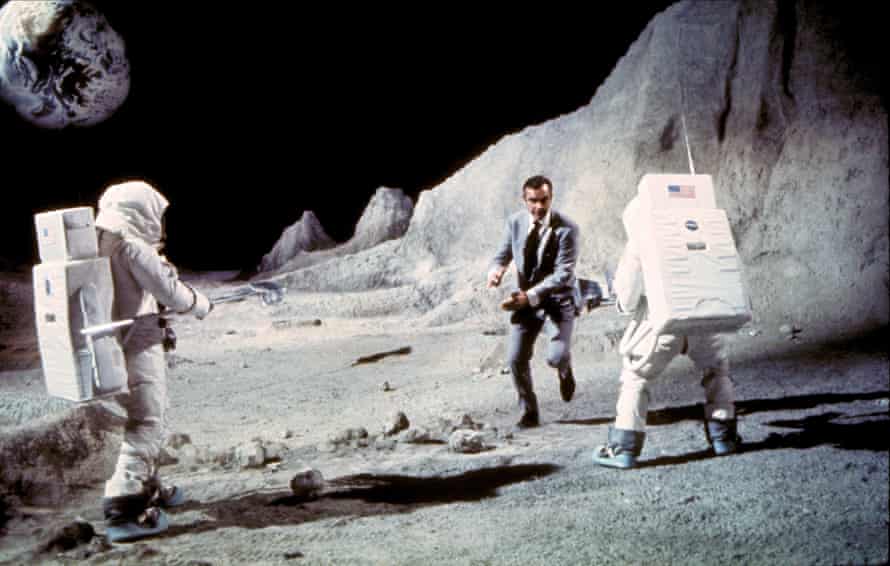
James Bond has to take a minor share of the arraign. In Diamonds Are Forever (1971), Sean Connery busts into a Nasa facility by way of a Las Vegas casino. A chase ensues across a film ready dressed up to look like the moon, consummate with earthbound astronauts. But here it's more like a visual joke, a mode of justifying a moon buggy chase beyond the Nevada desert. By the time of Peter Hyams' Kaysingian conspiracy thriller Capricorn One (1978), the idea that the government was fooling anybody was no laughing matter. Hither it'south virtually a Mars mission that goes wrong. The authorities opt to fake information technology and kill the astronauts (one of whom is played by OJ Simpson) to prevent them revealing the truth. In the postal service-Watergate era, the thought that the regime could lie on this scale had go much more than plausible.
Apollo marked a turning point between the optimism of the 60s and the disappointments of the 70s. "We can put a human being on the moon and so why can't we do X?" became a mutual refrain. Every bit Morton says: "Yes, the government can set itself an boggling goal and go on to accomplish it, only that doesn't hateful it can win the war in Vietnam, or clean up the inner cities, or cure cancer or any of the things that Americans might accept actually wanted more. The idea that the regime isn't really powerful, information technology just pretends it is – you can run across how information technology feeds into the moon hoax."
Moon-hoax theories tend to exist virtually what didn't happen rather than what did. Conspiracists are divided on whether the earlier Apollo, Mercury, Gemini and Atlas missions were besides fakes, whether Laika or Yuri Gagarin always fabricated it into space, and what role Kubrick played. Just while the first generation of lunar conspiracists were motivated by anger, these days it's more likely to be colorlessness. The line between conspiracy and entertainment is far more blurry.
Still, while irritating for those involved – Fizz Aldrin punched moon conspiracist Bart Sibrel in 2002 – in one sense the conspiracy thought is harmless, at to the lowest degree compared with misinformation about vaccinations or mass murders. Morton notes that information technology is 1 of the few conspiracy theories that isn't tainted by antisemitism. Nor does it seem to be ane to which Donald Trump, the ultimate product of news-as-entertainment, subscribes. The dynamics of the mod cyberspace accept clearly non helped: expect up Apollo videos on YouTube and shortly moon-hoax documentaries showtime lining up in the autoplay queue. But there is little show that Russian disinformation agents have spread moon conspiracies as they have anti-vaxxing propaganda, for case. Although, if you lot recall about it, it would make perfect sense for them to exercise so: a neat way of restoring Russian prestige while establishing continuity between the cold war and the data wars.
So again, the USSR had the means to expose the Americans at the time; it was listening in. "We were there at Soviet war machine base 32103," the Russian cosmonaut Alexei Leonov recently recalled. "I swear to God we sat in that location with our fingers crossed. We hoped the guys would brand it. Nosotros wanted this to happen. Nosotros knew those who were on lath and they knew united states of america, too."
The growing strength of the hoax theory is "ane of the things that happens as time recedes and these events are lost", laments Launius. "We've seen it with the second world war and the Holocaust. A lot of the witnesses are passing from the scene and it's easy for people to deny that it took identify. Who is left to counteract things that are untrue? Mythologies develop and become the dominant theme."
Peradventure the hardest affair to believe in is the idea that humans might take achieved something transcendent – something that even brought out the best in Nixon. "Because of what y'all have washed, the heavens have become part of man's globe," he said in his telephone phone call to Aldrin and Armstrong on the moon. "And as yous talk to united states of america from the Sea of Serenity, it inspires us to redouble our efforts to bring peace and tranquility to Earth."
We have less faith in ourselves these days. Most moon conspiracists treat the whole affair every bit a joke, a rabbit hole to get downwardly from fourth dimension to time. Peradventure if Nasa returns to the moon – maybe as early equally 2024, depending on Trump's whims – it will be replaced in time past Mars conspiracies.
Yet, you lot could see the persistence of the moon conspiracy as a compliment to the Apollo scientists. "In a fashion, the moon hoaxers are taking the Apollo missions far more seriously than about people do," says Morton. "It'due south a sign that they really care. They think that Apollo actually mattered." The truth is that the moon landings didn't actually change life on Earth. Not however anyway.
Source: https://www.theguardian.com/science/2019/jul/10/one-giant-lie-why-so-many-people-still-think-the-moon-landings-were-faked

Postar um comentário for "On Young the Resltess Why Are They Changing Phyllis Again?"